
By Andia Chakava, Managing Partner, Afrishela
Reading Time: 3 minutes, 35 seconds
Angel investing in Africa is more than writing an early cheque. It is about catalysing change at the intersection of gender equity and climate resilience – two forces that define the continent’s future. At Afrishela, we see angel investors as pivotal actors in Africa’s impact ecosystem, particularly at the nexus of gender and climate.
The numbers show why this matters. In 2025, African start-ups raised about US$3.2 billion, yet only 2.2% went to companies with a woman CEO – the lowest share since tracking began in 2019. All-female founding teams received less than 1% of the funding and gender-diverse teams 8%, while all-male teams took 91%.1 The gap is even larger for women-owned small businesses outside the venture capital spotlight.
For too long, women have been underrepresented in capital flows. Angel capital can accelerate a real wealth transfer to women entrepreneurs. But our lens should always go beyond ownership: at Afrishela we always ask whether a business uplifts livelihoods, increases women’s incomes across the value chain, and delivers tangible community benefits. For example, a renewable energy venture that brings light to rural areas doesn’t just provide electricity – it enables trading after dark, reduces crime, and allows children to study safely at night. This is the multiplier effect of impact-driven angel capital.
Angels are already proving to be part of the solution. The African Business Angel Network’s (ABAN) 2025 survey found that close to two-thirds of the angels and angel networks surveyed have invested in women-led companies, and 79% have backed youth-led ventures. Women now make up 37% of the angels surveyed.2 The commercial case is just as compelling: a Boston Consulting Group and MassChallenge study of start-ups found that women-founded businesses generated 78 cents in revenue for every dollar invested, compared with 31 cents for those founded by men.3
Our sector-agnostic approach embraces climate adaptation in agriculture (organic fertilisers, indigenous foods, post-harvest loss reduction) and renewable energy solutions that demonstrate measurable CO₂ reductions. We value founders who have undergone capacity-building programmes like Women Creating Wealth – evidence of investor readiness, financial discipline, and resilience.
This focus reflects where the need is greatest. Women make up roughly 70% of smallholder farmers across the continent, yet only 3% of climate finance targets gender equality, and sub-Saharan Africa needs an estimated US$2 trillion by 2030 to build climate resilience.4 Angels are responding: 32% of ABAN survey respondents pursue climate and impact sectors, and 20% focus on agriculture and agritech.2
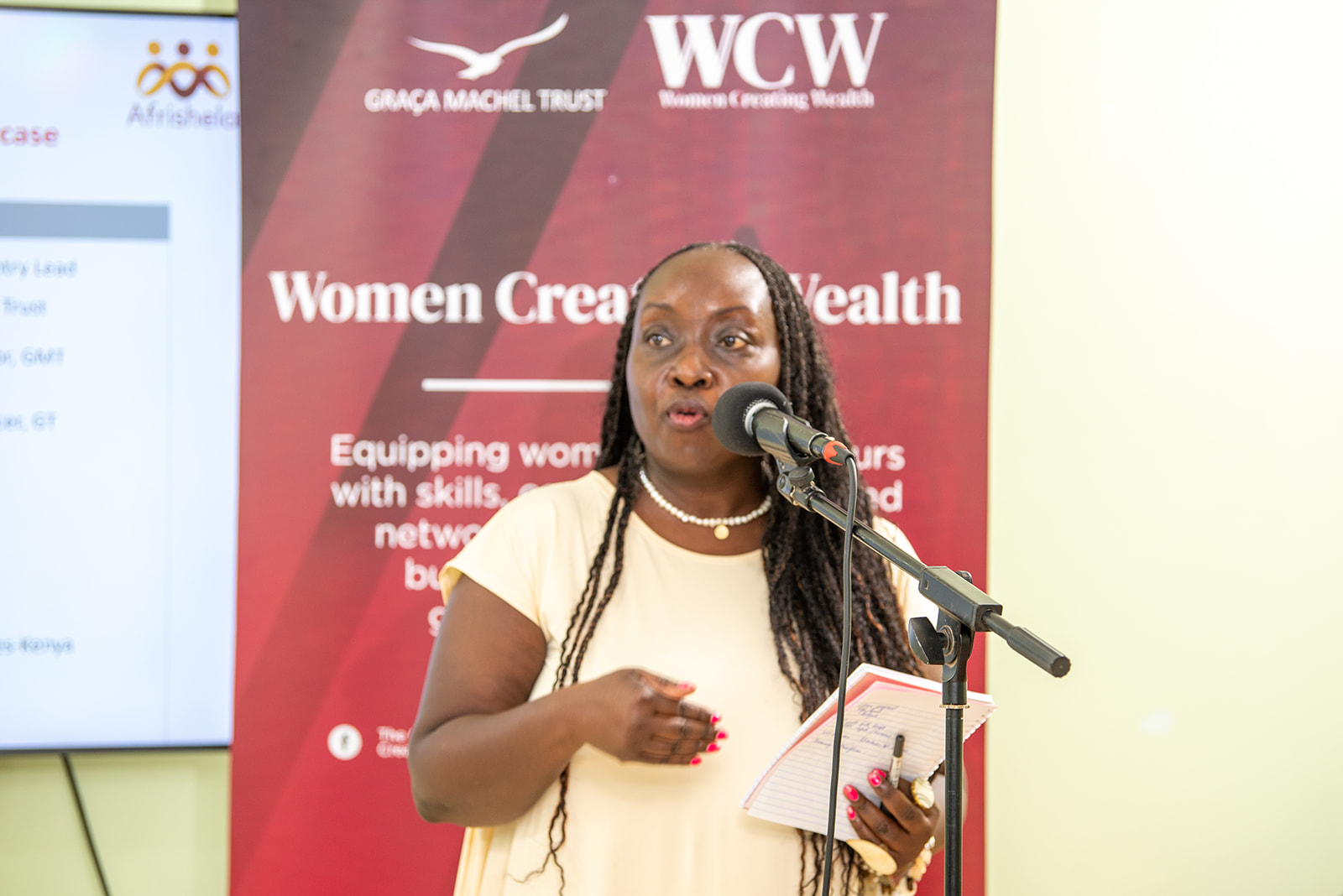
Andia Chakava, Managing Partner, Afrishela
Entrepreneurs should continue to seek out angel investors who can contribute more than capital. Advisory support, introductions to regulators, or mentoring leadership teams often prove as valuable as money. In one such experience, a founder offered equity in exchange for eight hours of monthly advisory support – a reminder that expertise and networks are assets in themselves.
Angel investing is also about community. Through networks like Rising Tide Africa and Chanzo Capital, investors pool resources, share skills, and collectively mentor businesses. This collaborative model stretches dollars further, democratises access, and ensures entrepreneurs outside elite circles can still attract early capital.
Pooling also reflects how angels invest on the continent. Most write small cheques – 90% of individual angels invest less than US$25,000 per deal – and around a quarter invest through syndicates. Kenya and South Africa, together with Nigeria and Egypt, account for about 80% of angel deals in Africa, which makes them natural places to grow women-focused angel communities such as the Afrishela and Rising Tide Africa programme.2
Impact investors should see angel investing as the first spark in a blended finance journey – one that validates entrepreneurs, unlocks institutional capital, and builds Africa’s next generation of resilient, gender-smart businesses that light homes, feed communities, and empower women to lead.
“Angel capital is catalytic because it moves first, and it moves with conviction. When a woman founder secures her first cheque from an angel who also brings advice and networks, it tells banks, impact funds and development finance institutions that the business has been tested and is worth backing. That is why we see angel capital as the baseline of the blended finance model: the early, relationship-based layer on which concessional and commercial capital can then build.”
References
- Africa: The Big Deal (2026). 2025 African start-up funding data by founder gender, as reported in “Female CEOs in Africa Receive Lowest Proportion of Funding Since 2019, Report Reveals,” TechMoran, 26 January 2026. https://techmoran.com/2026/01/26/female-ceos-in-africa-receive-lowest-proportion-of-funding-since-2019-report-reveals/
- African Business Angel Network (ABAN), UNDP and Briter Intelligence (2026). Angel Investment Survey Report 2025. https://abanangels.org/wp-content/uploads/2026/04/Final-ABAN-2025-Angel-Survey-Report-.pdf
- Abouzahr, K., Taplett, F. B., Krentz, M. and Harthorne, J. (2018). Why Women-Owned Startups Are a Better Bet. Boston Consulting Group and MassChallenge. https://www.bcg.com/publications/2018/why-women-owned-startups-are-better-bet
- Convergence (2026). Transformative Capital: The Role of Blended Finance in Shaping the Trajectories of Gender- and Climate-Focused Impact Funds in Sub-Saharan Africa. 10 February 2026. https://www.convergence.finance/resource/transformative-capital-the-role-of-blended-finance-in-shaping-the/view
